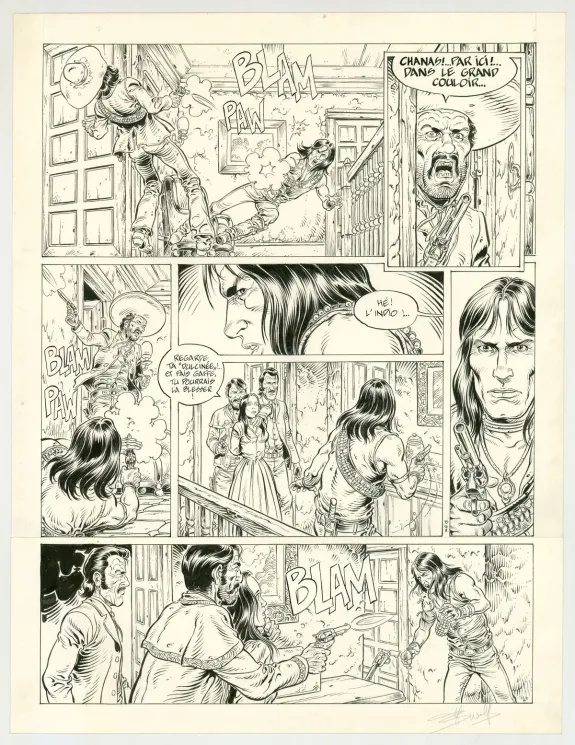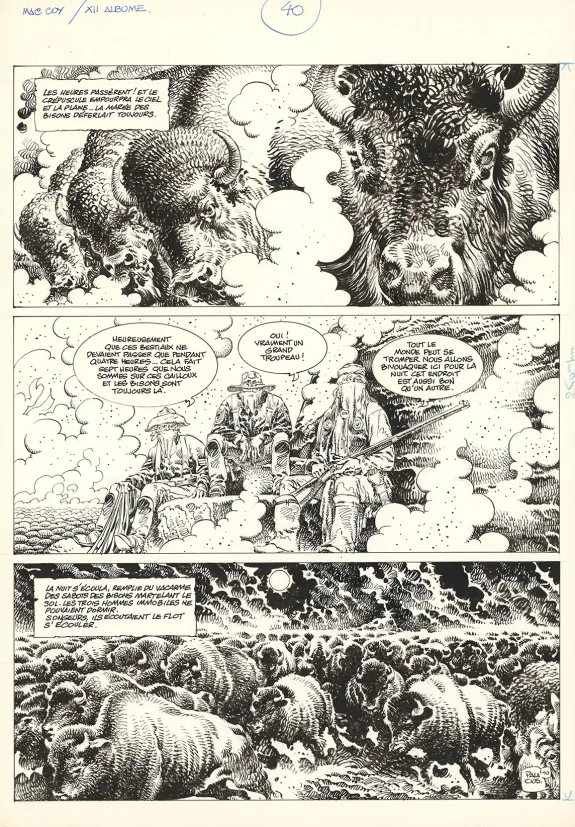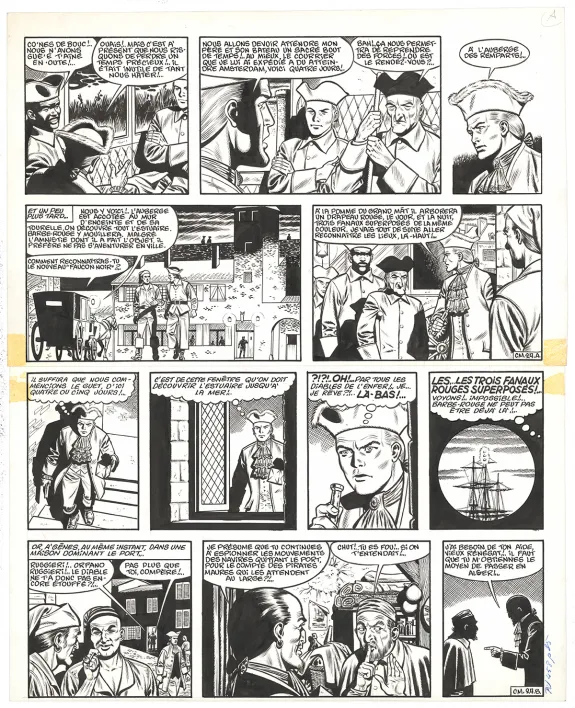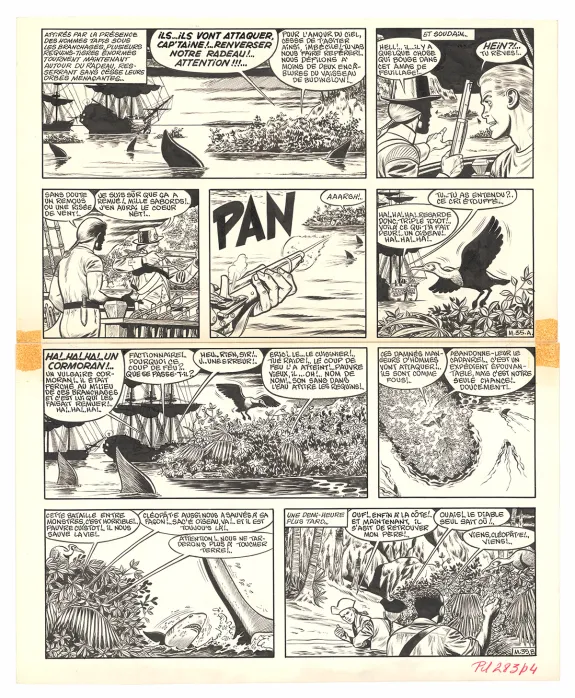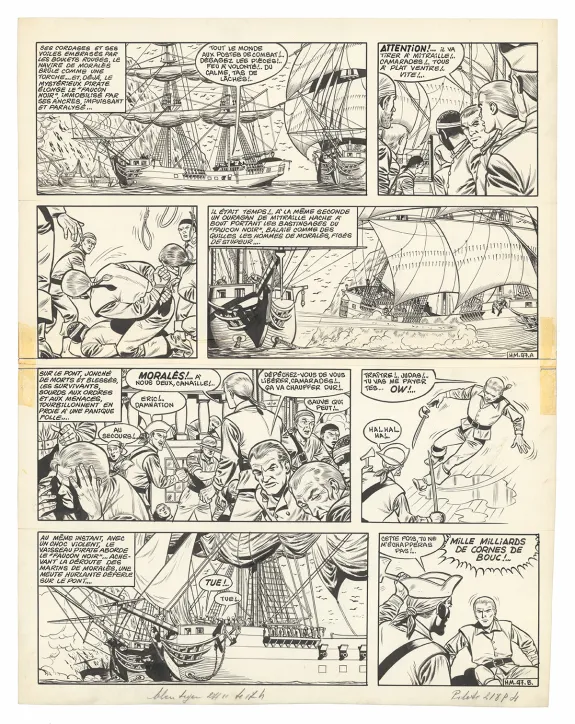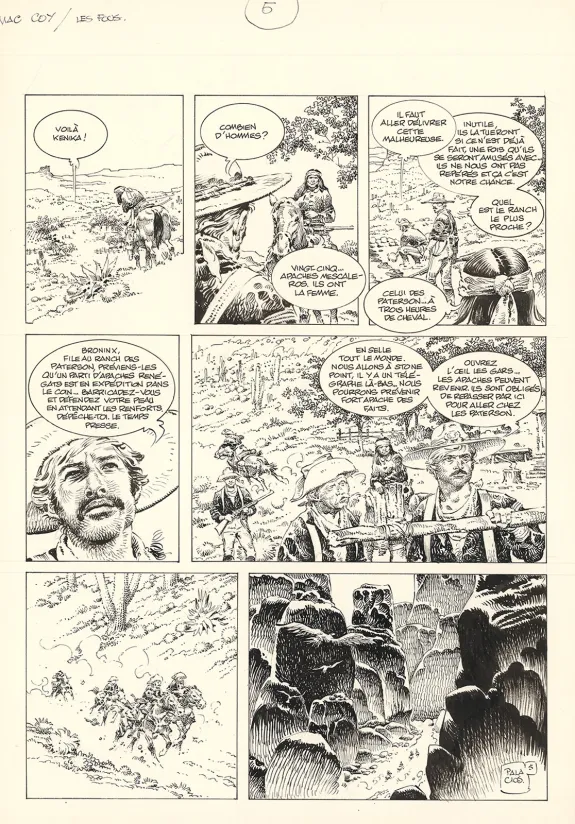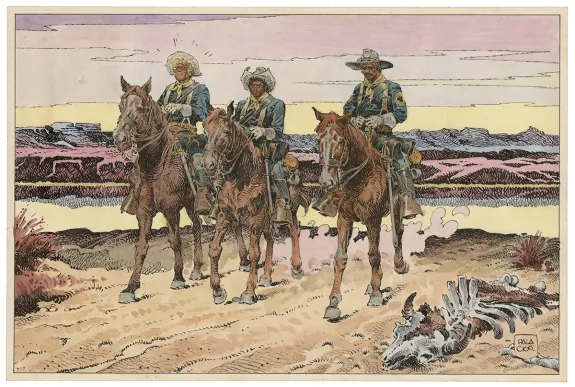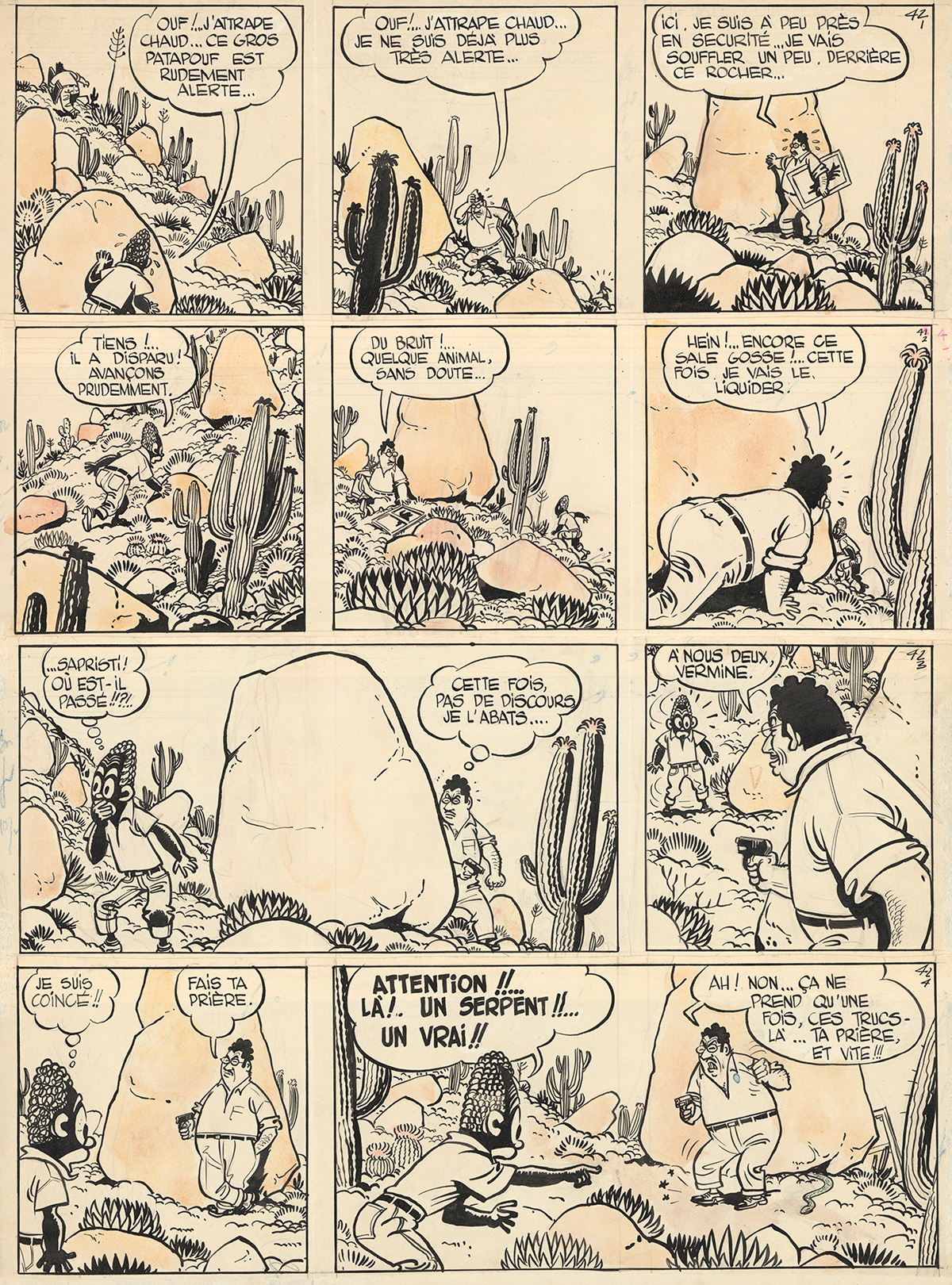
What strikes you first about Jijé is the quality of his inking, which combines pen and brush: fast, vigorous, effective, with a generous use of blacks. Then there’s his mastery of framing. In this story by Philippe Gillain, Sancho has managed to help his friend escape. But he’s under no illusions: the operation is doomed to fail, especially since Jerry Spring is exhausted. The scene is simple, alternating between close-ups and wide shots, with an interior monologue that strips away all background detail. This leads right up to the cliffhanger in the final panel: who is closing in on them? Their pursuers? The composition is flawless.
Regularly featured at auctions, Jijé’s market value reflects his place in the history of the comic strip; he was the spiritual father of a whole generation of artists whose careers took off (Franquin, Morris and Peyo, who were his assistants). Remarkably stable, Jijé’s market value remains at the upper end of the scale for classic comic book artists. Among his most notable sales are the cover of Fort Navajo, which sold for €39,900 (2015, Christie’s), and the splendid double-page spread from Duel, which went for €36,250 (2018, Christie’s).
To ensure that your pages are kept in good condition, we recommend that you never expose them to direct light, as UV rays can damage the media used to produce them. Although Indian ink is a perennial material, the paper support may change when exposed to UV light. Note that watercolor plates require special attention, as this medium is particularly sensitive to light. Pieces containing pastel or charcoal require special care to avoid rubbing.
We advise you to display them away from windows, and to use frames made of pH-neutral conservation materials and “Museum” glass with anti-UV and anti-reflective treatment. If you prefer to keep your works unframed, we recommend storing them flat, in drawing cartons, with sheets of pH-neutral permanent paper in between. Keep them away from light and humidity
A contemporary of Hergé, Joseph Gillain, known as Jijé, made his real debut in 1939 in Le Journal de Spirou, where he took over the title character in 1940. During the war, he became the backbone of the weekly magazine, producing realistic biographies such as Don Bosco and Christopher Columbus, followed by the Jean Valhardi series. After the Liberation, he mentored young artists (Franquin, Morris, Will)—the core of the Marcinelle School—before entrusting his series to them so he could devote himself to other projects. 1954 saw the birth of his masterpiece, the Western Jerry Spring, which he developed alongside several other titles. Always generous with advice to his colleagues, Jijé left a lasting mark on Franco-Belgian comics, inspiring even the pioneers of the “Atom Style” in the 1980s. Complete biography.