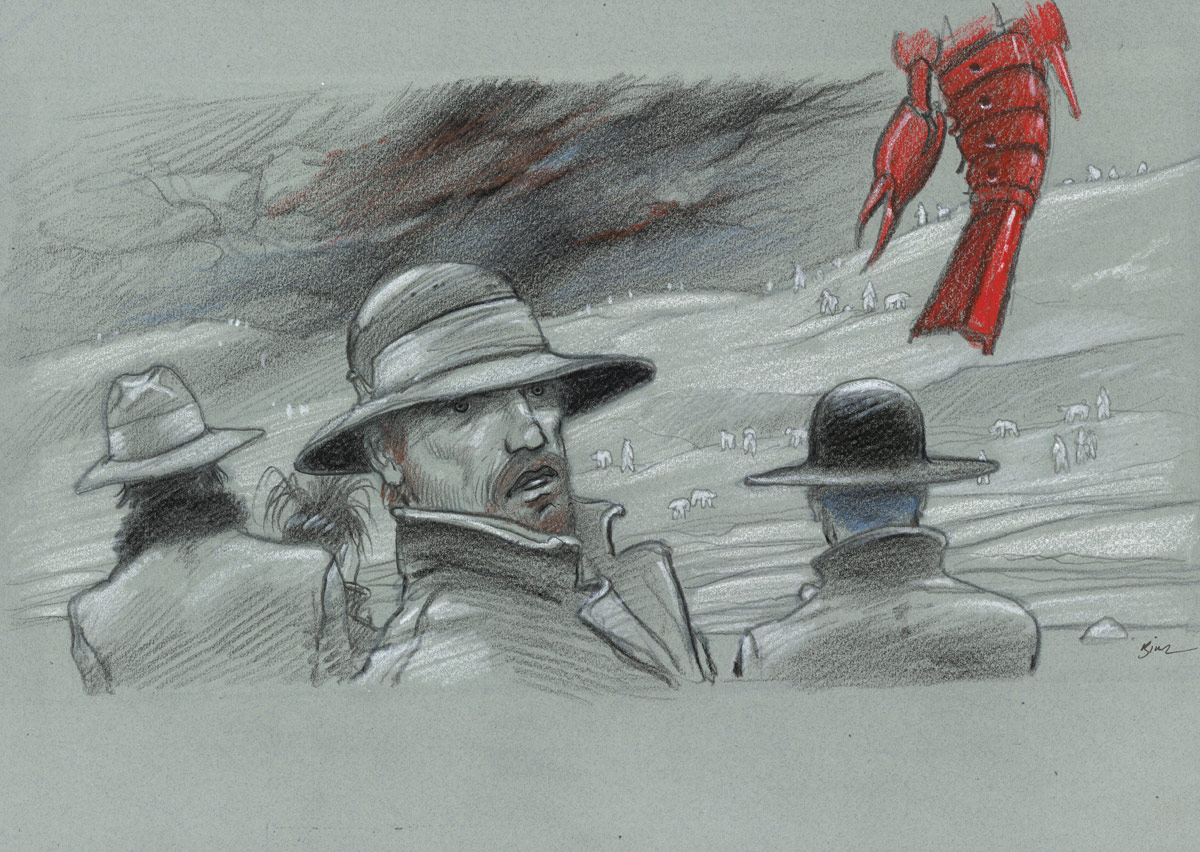
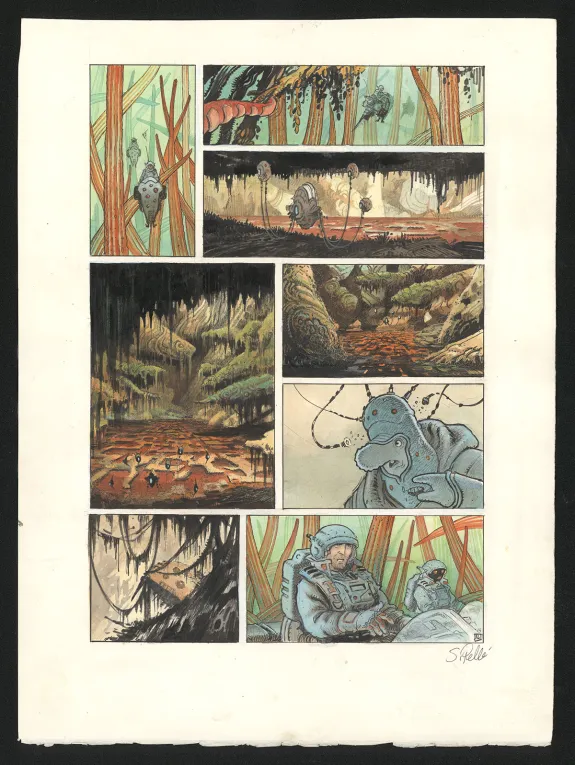
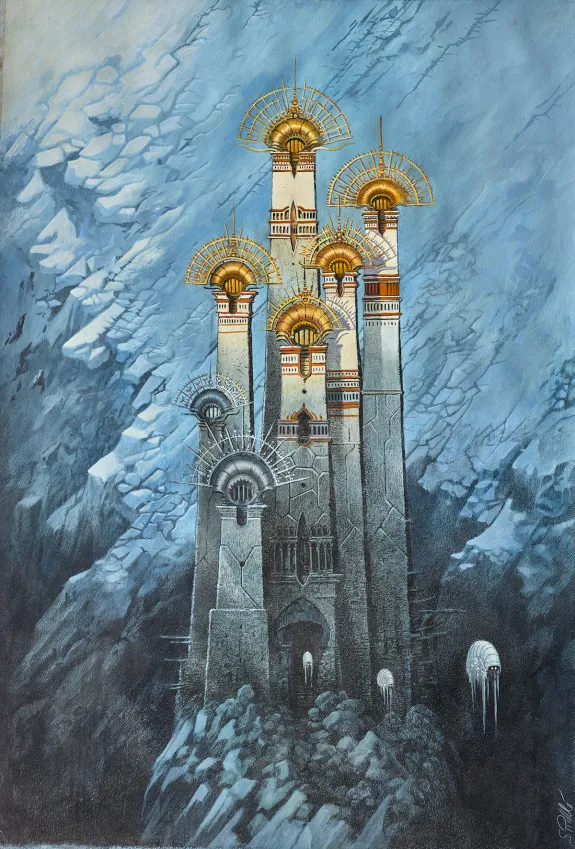
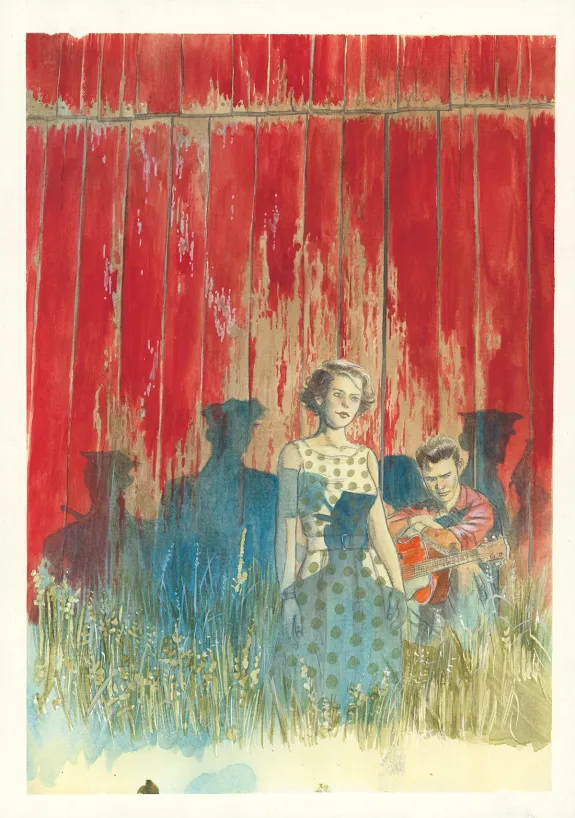
Enki Bilal is one of the leading figures in contemporary comic art, breaking the genre’s traditional conventions to reclaim them and transform them into something entirely new. His graphic and narrative choices, along with his highly recognizable style, make him a major figure in the Ninth Art.
Partie de Chasse (The Hunting Party) and La Trilogie Nikopol (The Nikopol Trilogy) mark key moments in the history of 1980s comic art. His eminently political themes and graphic talent have earned him international recognition: he is one of the most sought-after artists on the European scene, exhibiting in China, Japan, and even at the Louvre. His works are highly sought after on the art market, particularly the original pages for La Foire aux Immortels (The Carnival of Immortals), which set a world record in 2014 at Christie’s auction house, in partnership with Daniel Maghen, fetching a price of €115,500.
To ensure that your pages are kept in good condition, we recommend that you never expose them to direct light, as UV rays can damage the media used to produce them. Although Indian ink is a perennial material, the paper support may change when exposed to UV light. Note that watercolor plates require special attention, as this medium is particularly sensitive to light. Pieces containing pastel or charcoal require special care to avoid rubbing.
We advise you to display them away from windows, and to use frames made of pH-neutral conservation materials and “Museum” glass with anti-UV and anti-reflective treatment. If you prefer to keep your works unframed, we recommend storing them flat, in drawing cartons, with sheets of pH-neutral permanent paper in between. Keep them away from light and humidity.
Born in 1951 in Yugoslavia to a Bosnian father and a Slovak mother, Enki Bilal arrived in Paris in 1960 and, in 1971, won a comic strip contest for Pilote, where he published Le Bol maudit (1972). His collaboration with Pierre Christin in 1975 marked the beginning of an early period characterized by strong political themes: the trilogy Légendes d'aujourd'hui (1975–1977), followed by the diptych Les Phalanges de l'ordre noir (The Phantoms of the Black Order, 1979) and Partie de chasse (1983). At the same time, he made his mark in science fiction with Exterminateur 17 (1979) and the Nikopol trilogy—La Foire aux immortels(1980), La Femme Piège (1986), and Froid Équateur(1992)—revolutionizing the use of direct color in comic art. Winner of the Angoulême Grand Prix in 1986, a Knight of the Order of Merit, and an Officer of the Order of Arts and Letters, he simultaneously pursued a career in film (Bunker Palace Hotel, 1989; Tykho Moon, 1996; Immortel (ad vitam), 2004) and continues his comics work with the Tétralogie du Monstre (1998–2007) and the Coup de sang trilogy (2009–2014). His work has been exhibited at the Louvre and the Musée des Arts et Métiers; according to L’Express, he is one of the most highly valued living French artists on the international market. In 2026, he opened the Fonds Enki Bilal in Paris, a space dedicated to the diverse forms of contemporary art. Complete biography.