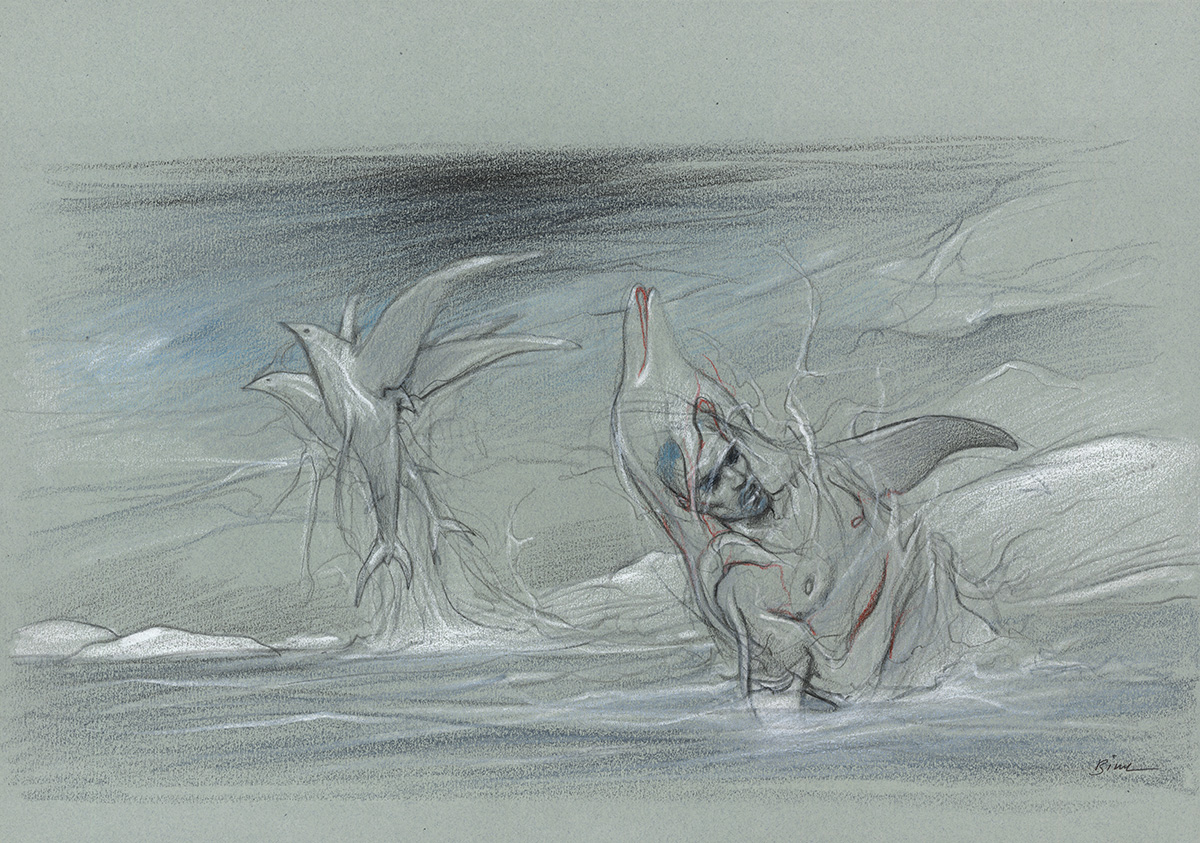
Born in 1951 in Yugoslavia to a Bosnian father and a Slovak mother, Enki Bilal arrived in Paris in 1960 and, in 1971, won a comic strip contest for Pilote, where he published Le Bol maudit (1972). His collaboration with Pierre Christin in 1975 marked the beginning of an early period characterized by strong political themes: the trilogy Légendes d'aujourd'hui (1975–1977), followed by the diptych Les Phalanges de l'ordre noir (The Phantoms of the Black Order, 1979) and Partie de chasse (1983). At the same time, he made his mark in science fiction with Exterminateur 17 (1979) and the Nikopol trilogy—La Foire aux immortels (1980), La Femme Piège (1986), and Froid Équateur (1992)—revolutionizing the use of direct color in comic art. Winner of the Angoulême Grand Prix in 1986, a Knight of the Order of Merit, and an Officer of the Order of Arts and Letters, he simultaneously pursued a career in film (Bunker Palace Hotel, 1989; Tykho Moon, 1996; Immortel (ad vitam), 2004) and continues his comics work with the Tétralogie du Monstre (1998–2007) and the Coup de sang trilogy (2009–2014). His work has been exhibited at the Louvre and the Musée des Arts et Métiers; according to L’Express, he is one of the most highly valued living French artists on the international market. In 2026, he opened the Fonds Enki Bilal in Paris, a space dedicated to the diverse forms of contemporary art. Complete biography.