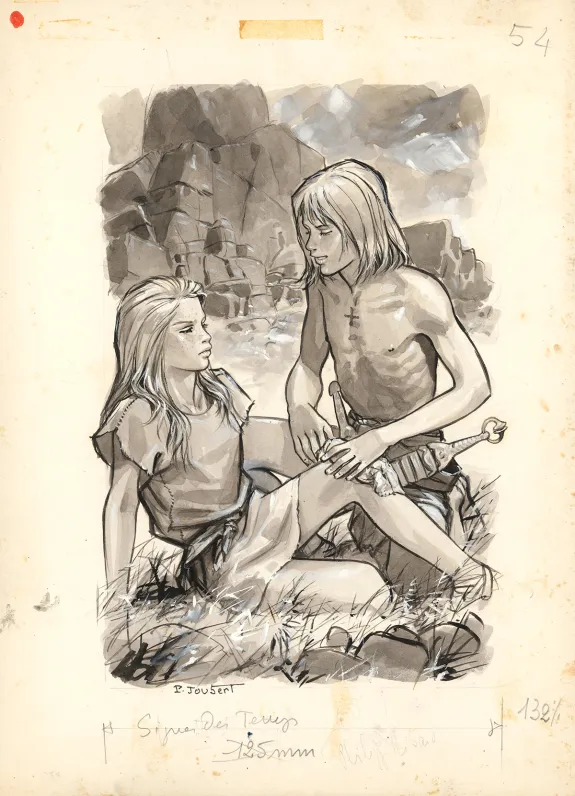
A leading figure of the Marcinelle School, MiTacq distinguished himself through numerous stories for young readers that have fueled the imagination and thirst for adventure of several generations of readers. When he launched La Patrouille des Castors (The Beaver Patrol) in 1954, he developed a clear and dynamic style that blends perfectly with Scout adventures. The richness of the natural backgrounds, rendered with meticulous detail, provides a backdrop that anchors the Beavers’ adventures in a believable world of heightened realism. Along with Pierre Joubert, he is a major representative of Scouting in the Ninth Art.
Prized for his artwork in the field of Scouting, MiTacq commands a stable and relatively affordable market value compared to his contemporaries. The original pages from La Patrouille des Castors (The Beaver Patrol) remain the most sought-after, particularly the complex spreads where all the protagonists are depicted. A must-have for any Scouting enthusiast.
To ensure that your pages are kept in good condition, we recommend that you never expose them to direct light, as UV rays can damage the media used to produce them. Although Indian ink is a perennial material, the paper support may change when exposed to UV light. Note that watercolor plates require special attention, as this medium is particularly sensitive to light. Pieces containing pastel or charcoal require special care to avoid rubbing.
We advise you to display them away from windows, and to use frames made of pH-neutral conservation materials and “Museum” glass with anti-UV and anti-reflective treatment. If you prefer to keep your works unframed, we recommend storing them flat, in drawing cartons, with sheets of pH-neutral permanent paper in between. Keep them away from light and humidity
Michel Tacq, known as MiTacq, attended the Saint-Luc art school in Brussels starting in 1942. Six months later, he was forced to put his studies on hold to support his family. He then took technical courses in industrial design at the Aumôniers du Travail in Charleroi. In 1951, he joined World’s Press, headed by Georges Troisfontaines, for whom he drew about twenty Belles histoires de l’Oncle Paul (The Beautiful Stories of Uncle Paul) and numerous educational pages for the Coin du petit curieux (The Curious Little One's Corner) section. Heavily influenced by Pierre Joubert, MiTacq sketched out a project for a Scout-themed comic strip, La Patrouille des Castors (The Beaver Patrol), which he pitched to World’s. Although the publisher accepted the idea, he entrusted the script to an experienced writer: Jean-Michel Charlier, who would write the first 21 albums in the series. When Pilote was launched, Charlier proposed a new series to MiTacq: Jacques Le Gall, a teenager who embarks on numerous adventures directly tied to various contemporary issues (Mediterranean traffickers, Nazi treasure, and more). The series would span 6 albums. Complete biography.