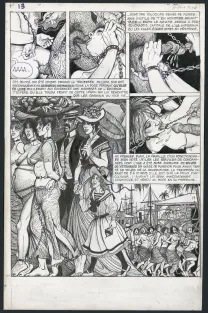
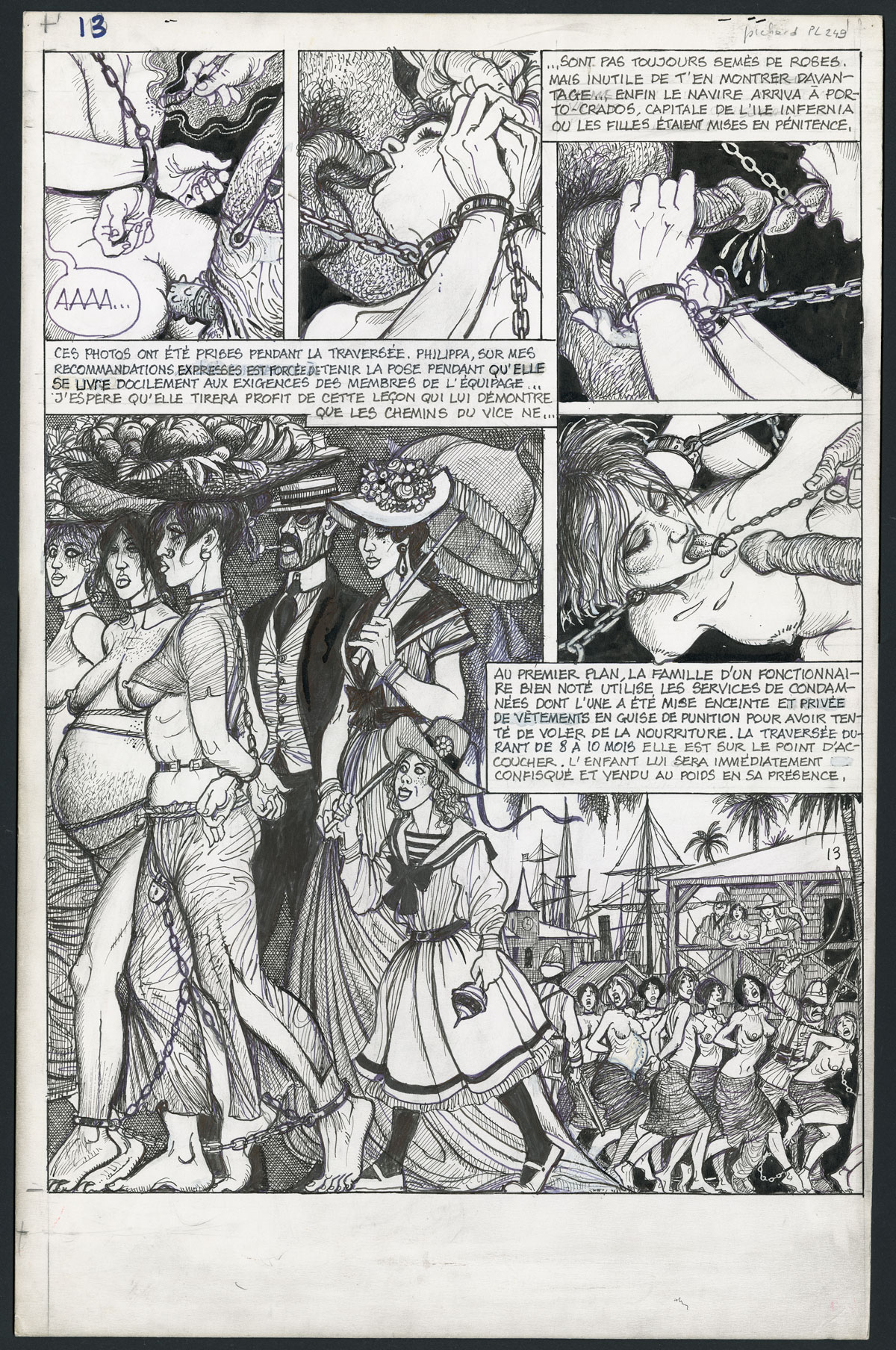
Pichard’s style is characterized by stark contrast and thick, bold lines that powerfully define his voluptuous, stylized women. Far removed from the fluidity of Milo Manara, the ethereal style of Guido Crepax, or the realism of Paolo Eleuteri Serpieri, Pichard distinguishes himself with a very direct approach, relying exclusively on the radical contrast between black and white. His is a raw, unadorned line perfectly suited to highlight the shadow side hidden within the vicissitudes of human life. His graphic aesthetic, almost decorative, makes him one of the masters of adult comics from the 1970s.
A master of French erotic comic art, his works remain relatively obscure and rare on the market.
To ensure that your pages are kept in good condition, we recommend that you never expose them to direct light, as UV rays can damage the media used to produce them. Although Indian ink is a perennial material, the paper support may change when exposed to UV light. Note that watercolor plates require special attention, as this medium is particularly sensitive to light. Pieces containing pastel or charcoal require special care to avoid rubbing.
We advise you to display them away from windows, and to use frames made of pH-neutral conservation materials and “Museum” glass with anti-UV and anti-reflective treatment. If you prefer to keep your works unframed, we recommend storing them flat, in drawing cartons, with sheets of pH-neutral permanent paper in between. Keep them away from light and humidity
Trained in applied arts, Georges Pichard (1920–2003) first taught graphic arts before turning to comic art later in life. He made his true debut in 1964 in the weekly magazine Chouchou, but it was his meeting with writer Jacques Lob that would set his course: in 1967, Submerman appeared in Pilote, while Blanche Épiphanie—a heroine who defied the moral norms of the time—began her career in V Magazine, sparking a strong public reaction. The turning point was reached: Pichard gradually moved away from all-ages comic art toward the erotic world that would make his reputation. Beginning in 1977, he became a full-fledged creator and turned his attention to openly erotic, even pornographic, stories (some of his albums, such as Maison de correction Princesse Mélanie (The Princess Melanie Reform School), remain banned in several countries). Drawing inspiration from Art Nouveau, Robert Crumb, and Sadean imagery, he established himself as one of the leading figures in adult comics of his time, cultivating a fruitful paradox until the very end: applying the most classical precision of line to the most transgressive subjects. Complete biography.