Moebius
Topics :
- Science fiction
- Classical
- The Incal Universe
- Occult
- Adventure
- Thriller
- Super heroes
Two Lives in One Stroke: Blueberry's and Arzach's
At the age of fifteen, Jean Giraud enrolled at the École des Arts Appliqués in Paris, where he quickly developed a consuming passion for science fiction in postwar France, at a time when the genre was just beginning to find its place in youth publications. His first comic strips appeared as early as 1956 in iconic titles of the era—Far West, Fripounet et Marisette, Âmes vaillantes—before a pivotal encounter in 1958 sealed his fate as a comic artist: his meeting with Jijé, the leading figure of the Marcinelle School, who took him under his wing and entrusted him with drawing several pages for Jerry Spring.
As Pilote magazine exploded onto the scene, transforming into a laboratory for comic art undergoing radical change, Giraud created in 1963, with Jean-Michel Charlier, the series that would bring him fame: Fort Navajo, soon renamed Blueberry. That same year, under the name Moebius, he published his first pages in Hara-Kiri—an early sign of an artistic duality that would become the hallmark of his entire career. For more than a decade, Gir the realist and Moebius the experimental creator coexisted, the former establishing a well-researched and demanding Western, while the latter explored freer and more ethereal forms.
In the mid-1970s, the Dargaud brothers stripped Giraud of his signature character following a dispute. This break marked one of the defining moments in the history of modern comic art: alongside Philippe Druillet, Jean-Pierre Dionnet, and Bernard Farkas, he helped found the magazine Métal Hurlant and Les Humanoïdes Associés, a publishing house that would permanently transform the status of comic art in France—which until then had been confined to a youth audience. Breaking with the conventions of traditional comics—which they found mired in a realistic straitjacket designed for young readers—the four men became the spearhead of a wholly new form of comic art: adult, experimental, and free from constraints. Moebius found in this movement a space of total freedom, which he began to explore as early as 1976 with Arzach, a nearly wordless and visually radical narrative. His collaboration with Alejandro Jodorowsky, which began in 1978, gave rise to a partnership that left a lasting mark on both comic art and the science fiction genre in the broadest sense. L’Incal remains their most famous achievement—a work that would profoundly influence genre cinema in the decades that followed, from Star Wars to Alien.
This dual artistic life did not prevent him from reuniting with Charlier, five years after their last album, to continue Blueberry, whose success remained undiminished until the writer's sudden death in 1989. Following Charlier's passing, Giraud took over the writing of the series alone, while exploring, through Marshal Blueberry, a new way of conveying his universe to other artists. Recognized by his peers, he was named Best Graphic Artist by Minister Jack Lang and awarded the Order of Arts and Letters by François Mitterrand in 1985. This accolade served as a belated yet resounding recognition and validation of comic art as a full-fledged art form in France. However, his influence extended beyond the Ninth Art: sought after by the American film industry as early as the late 1970s, he designed the costumes for Alien directed by Ridley Scott and those for Tron directed by Steven Lisberger—an experience that left a profound mark on him. He explained in an interview with Amusement magazine in 2010:
“I’m very proud to have worked on Tron. The film is still based on a story, but the fact that it’s made of computer-generated imagery changes everything. Back then, to explain to me what these images—which no one knew about—were, they took me to MIT to see the people who were developing the technology. [...] It was so extraordinary that I was dumbfounded, overwhelmed by information. I’ve never been able to fully convey everything I saw. But what those engineers were doing was amazing because they were tasked with conducting experiments; they were explorers armed with software and mathematical principles. The guys had to create looping animations with perspective. And since they had no artistic background, they did it with giraffes, pianos, and circles. On their screens, it looked like funny carousels spinning in all directions. And there you have it: without even realizing it, these engineers were tapping into the very essence of cinema—that is, a fascinating art form. Essentially fascinating.
Moebius is one of the few French artists to have had such an influence on Hollywood’s visual imagination (Little Nemo, Willow, The Abyss, and Luc Besson’s The Fifth Element). Approached by Marvel in 1988 to work on an issue of Silver Surfer, he also became the first French artist to achieve such recognition in the United States, paving the way for an entire generation of European artists in the American industry.
Jean Giraud passed away in Paris on March 10, 2012, at the age of 74, leaving behind a dual and inseparable body of work—the rigorous and sensual work of Gir; and the dreamlike and phantasmagorical work of Moebius—which permanently marked the global comic art scene and redefined the boundaries between comic art, science fiction, and cinema.
On n'image pas l'impact qu'a eu Arzak, publié par Moebius en 1975 dans les premiers numéros de Métal Hurlant, sur le monde de la bande dessinée. Cette œuvre apollinienne (selon la définition de Nietzsche) marque une césure nette dans l'histoire de la bande dessinée. Avec ce cavalier mutique juché sur un ptéroïde, Jean Giraud rompt brutalement avec le récit classique pour inventer un langage de la vision pure, débarrassé des dialogues et des codes narratifs hérités du feuilleton. L'image devient tout : elle raconte, respire, médite… Ce que propose Arzak, c'est la bande dessinée comme expérience intérieure. Loin des aventures bavardes du franco-belge traditionnel, Moebius ouvre une brèche métaphysique dans cet univers où domine l'aventure. Dans ces planches muettes, chaque case semble suspendue entre rêve et abstraction. Le lecteur ne "lit" plus une histoire : il traverse un espace mental, un désert peuplé de signes. Cette approche radicale transforme l'acte de lecture en contemplation, sinon en sidération.
Didier Pasamonik - Extrait du catalogue Daniel Maghen Enchère 2025
Moebius aux enchères

MOEBIUS
MAJOR FATAL
Les Humanoïdes Associés 1979
Original artwork from Jerry Cornélius’s Hermetic Garage, first published in Métal Hurlant no. 16, April 1977. Signed.
23 × 27 cm
Sold in 2023 : 67000€
Credits :
© Moebius, 2026 (banner)
Pages and artworks from Moebius See all


You will also like...
-
-
-
-
-
-
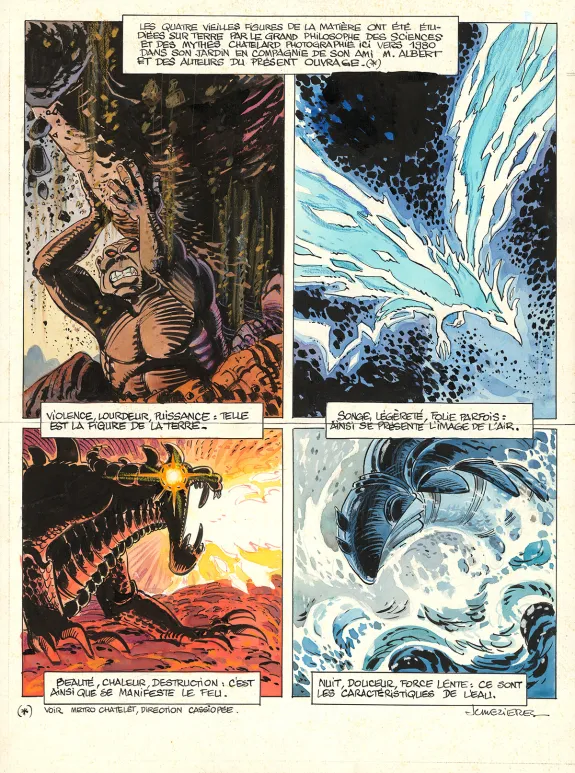
Jean-Claude Mézières
Valérian
Original page, unedited introduction to the episode Métro Châtelet Terminus Cosmos (1981)
5 000 € -
-

-
-
-
-