

Hugo Pratt
Topics :
- Classical
- Adventure
- Sailing
- Western
- Historical
- Social timeline
- Action
Hugo Pratt, the Artist Who Changed the Course of Comic Art
When Hugo Pratt (1927–1995) described his life, he explained: “I have thirteen ways of telling my life story, and I don’t know if any of them is true, or even if one is truer than the others.” Yet, the version that rings truest of all is his body of work. In it, he weaves the core elements of his youth: his childhood in Venice, his Jewish heritage, his time in Ethiopia with his father—a career military officer—and his return to a Venice still under German occupation. There, he was arrested by the SS on suspicion of espionage before being forcibly enlisted into the Reich’s maritime police. A few days later, he defected to the Allied side, serving first as an interpreter and then as a show organizer. However, it was his meeting with Mario Faustinelli and Alberto Ongaro that marked a decisive turning point in his career toward drawing and comic art, establishing himself as a leading figure of the Italian school. As early as 1952, he created Sergeant Kirk for the magazine Misterix (published by Editorial Abril), followed by Ticonderoga for the magazine Frontera, and Ernie Pike for the magazine Hora Cero – two titles published by Héctor Germán Oesterheld's own publishing house. His many travels fueled his imagination and provided the backdrop for his stories: while in London, he drew war stories for Fleetway; in Buenos Aires, Fort Wheeling and Captain Cormorant (1964); and finally back in Italy, where he drew The Shadow and Billy James (1962) alongside adaptations of literary classics (Stevenson’s Treasure Island and Kidnapped!).
His artwork, initially heavily inspired by the style of Milton Caniff, became more experimental over time, sometimes bordering on abstraction—particularly under the influence of his friend, the artist Alberto Breccia, whom he met in Buenos Aires. His linework, though precise, emphasized fluidity, giving it a unique, distinctive, and timeless touch. As such, he belongs to a generation of Italian masters of black-and-white comics who left an indelible mark on their era and whose international influence remains profound (Guido Crepax, Dino Battaglia, Guido Buzzelli, Attilio Micheluzzi, Sergio Toppi, …). Ultimately, it was through his storytelling—in which he sometimes used long, contemplative sequences—that Hugo Pratt would revolutionize the world of comic art starting in the late 1960s.
June 1967 marked a turning point: Lorenzo Ivaldi launched the magazine Sergent Kirk, which featured, in its very first issue, the opening pages of La Ballade de la Mer Salée (The Ballad of the Salty Sea). Corto Maltese made his debut there, followed closely by The Scorpions of the Desert (The Scorpions of the Desert). That same year, the French comic book critic and historian Claude Moliterni— co-founder of the Angoulême International Comics Festival (then known as the Salon International de la Bande Dessinée)—introduced him to Georges Rieu, the editor of Pif Gadget. This magazine, affiliated with the French Communist Party, had an extraordinary readership at the time, reaching up to 800,000 copies per week! In April 1970, a certain sailor with sideburns embarked on his first solo adventure in Le Secret de Tristan Bantam. This marked the true beginning of Hugo Pratt’s career in France. Between 1973 and 1974, readers of France Soir were introduced to La Ballade de la mer salée (The Ballad of the Salty Sea). This album was published in January 1975 by Casterman to coincide with the second Angoulême International Comics Festival, as part of a series quickly dubbed “The Great Comic Art Novels”—a precursor to the contemporary graphic novel and the magazine À Suivre. At the same time, the first episodes of The Scorpions of the Desert appeared in Le Journal de Tintin. From that point forward, Pratt’s success would never wane.
This marked the beginning of a string of accolades, culminating in the Best Album Award at the Angoulême International Comics Festival in 1976—the first of many, including the Grand Prix for the 15th Anniversary of the Festival in 1988, a Max and Moritz Award in 1996, and an Eisner Award Hall of Fame induction in 2005. Several of Hugo Pratt’s works have been adapted for the screen, including Jesuit Joe by Olivier Austen (1991) and Corto Maltese : La Cour secrète des Arcanes (Corto Maltese: The Secret Court of the Arcanes) by Pascal Morelli (2002), which was produced alongside an animated miniseries by Richard Danto and Liam Saury between 2002 and 2003.
For me, today, graphic art begins with the necessity of a line and moves toward the imperative of the word. Thus is the comic book born.
Hugo Pratt
Credits :
©Pratt, Casterman (banner)
Pages and artworks from Hugo Pratt
No artworks are available at this time. Log in or create an account to set up alerts and never miss a new release from your favorite artists or comics !
You will also like...
-
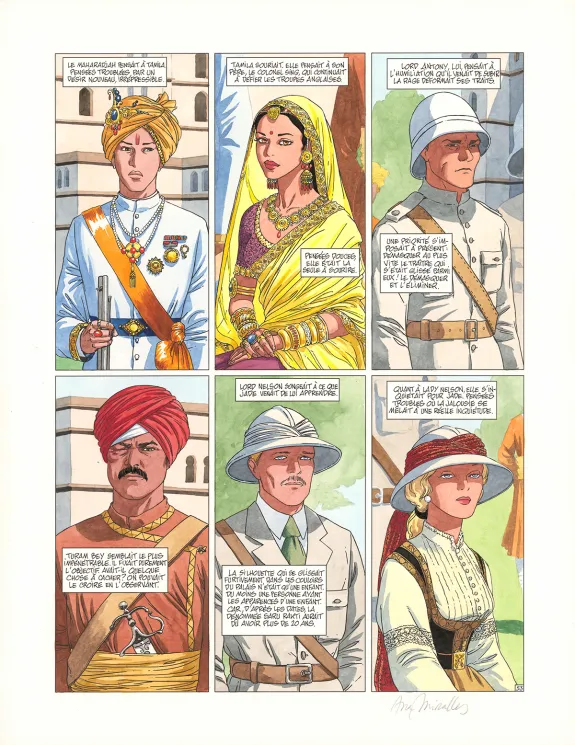
Original page n°53 with 6 preparatory steps in graphite on tracing paper
2 000 € -
-
-
-
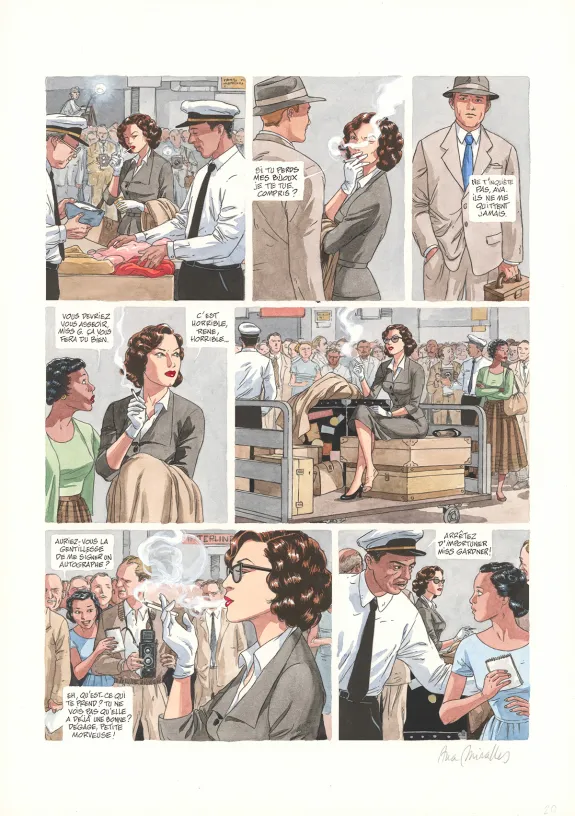
Ana Miralles
Ava, quarante-huit heures dans la vie d'Ava Gardner
Original page 20 in semi-direct colours
3 000 € -
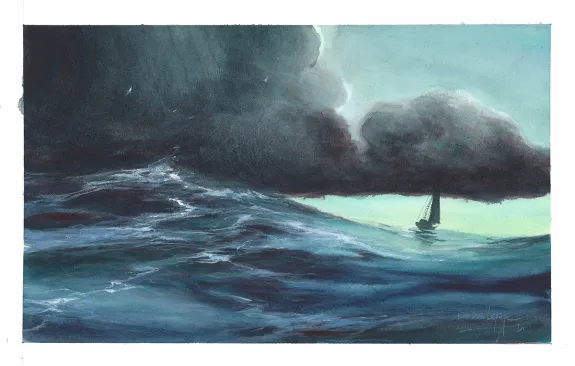
"La Belle Poule in the Distance." Original illustration (2026)
3 000 € -
-
-
-
-
-
Contenu sensible


