Edgar P. Jacobs
Topics :
- Classical
- Crime novel
- Action
- Adventure
- Western
Edgar P. Jacobs, from Opera Singer to Comic Art Legend
An Anglophile to the point of changing his name (Edgard Félix Pierre Jacobs, 1904–1987), Edgar P. Jacobs made a late and unexpected debut in comic art at the age of 39, in 1943. Previously, even though he had studied at the Royal Academy of Fine Arts in Brussels alongside Jacques Laudy and Jacques Van Melkebeke (his teacher was Constand Montald, who also taught René Magritte and Paul Delvaux), he had intended to pursue a career as a baritone. Before the war, he performed at the Lille Opera, but World War II thwarted that path.
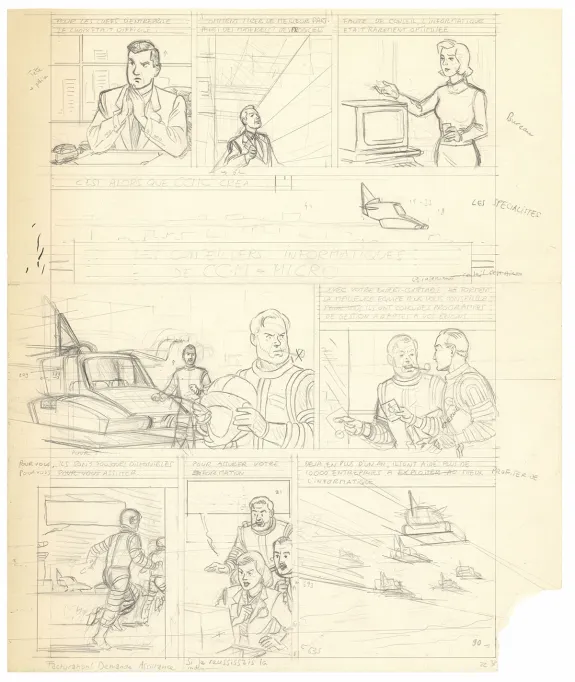
Thanks to his friend, the painter and comic artist Jacques Laudy, he took his first steps at the magazine Bravo. There, he quickly wrapped up the adventures of Flash Gordon—an American comic strip by Alex Raymond that had been banned by the German occupiers—and began a similar series blending fantasy and science fiction. But while he was naturally inspired by the American master he was supposed to replace, unlike him, he was not influenced by cinema. His artwork is more measured, solemn, idealized, and composed of meticulous small watercolors in direct colors.
Introduced to Hergé by Jacques Van Melkebeke, Jacobs worked on the redesign of the albums Tintin in the Congo, Tintin in America, King Ottokar’s Sceptre, and The Blue Lotus in 1943, notably developing for Hergé the famous color palette that would make the series a success. He then collaborated on the artwork and settings for The Seven Crystal Balls and Prisoners of the Sun. A spirit of mutual inspiration developed between the two men: from Hergé, Jacobs learned the basics of comic art; from Jacobs, Hergé learned the secrets of color as well as the rigor of composition and storytelling. Together, they laid the foundation for what would come to be known as the Brussels School, a pillar of Belgian comics. With the launch of Le Journal de Tintin in 1946, Jacobs created the series The Adventures of Blake and Mortimer starting with The Secret of the Swordfish, an alternate-history tale imagining World War III, one of the pinnacles of the Brussels School. In just ten albums, he established himself as one of the undisputed masters of the global comic art world: following The Mystery of the Great Pyramid, serialized in Tintin Magazine beginning March 23, 1950, he created The Yellow Mark (1953), considered his masterpiece. This was followed by The Enigma of Atlantis (1955), S.O.S. Meteors (1957), The Diabolical Trap (1960), and The Necklace Affair (1965). In 1971, he published his final Blake and Mortimer story, The Three Formulas of Professor Sato, whose second volume was completed after his death by Bob De Moor, in 1990. Blending the great literary myths of the 19th century (Jules Verne, H. G. Wells, etc.) with a perfectly refined artistic style, Edgar P. Jacobs would go on to have a profound and considerable influence on Franco-Belgian comics and the world of comic art at large. Taken up by several successors, the series is now one of the best-selling titles in the publishing world today.
Having studied painting at the Royal Academy in Brussels, alongside Jacques Laudy and Jacques Van Melkebeke – who would later become the models for Blake and Mortimer – Jacobs stood out for his skill as a colourist. He put this talent to use for Hergé: from 1943 onwards, he produced the colour versions of the Tintin albums. The ‘blue-colouring’ process allowed the famous ‘Clear Line’ style to be separated from a three-colour scheme comprising refined blocks of monochromatic shades, characteristic of the colouring techniques of the Brussels School.
Didier Pasamonik
Credits :
©E.P. Jacobs, éd. Blake et Morimer (banner)
Pages and artworks from Edgar P. Jacobs
No artworks are available at this time. Log in or create an account to set up alerts and never miss a new release from your favorite artists or comics !
You will also like...
-
-
-
-
-
-
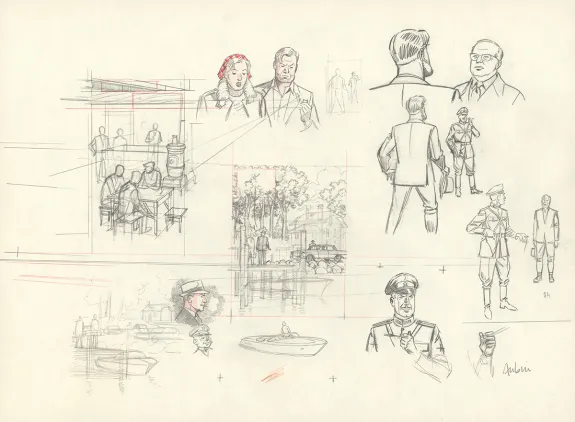
Original Sketch, Study
2 700 € -
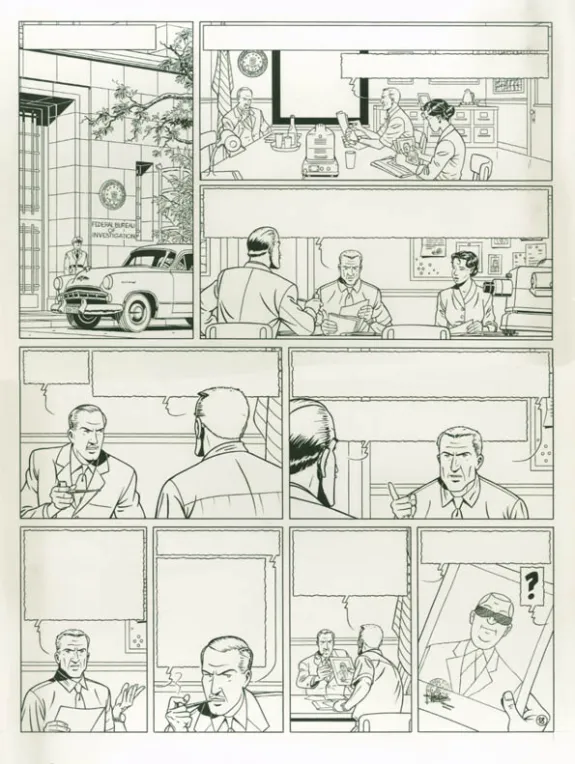
p18
2 300 € -
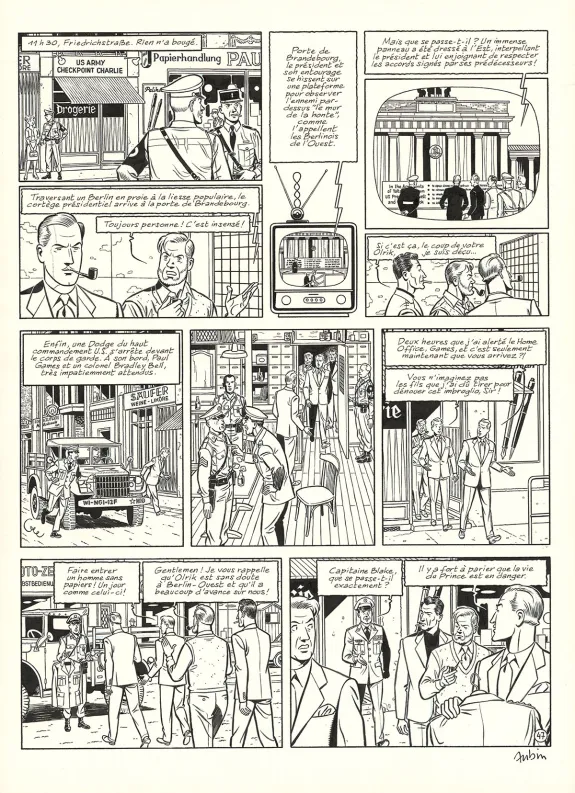
Original page n°47
6 000 € -
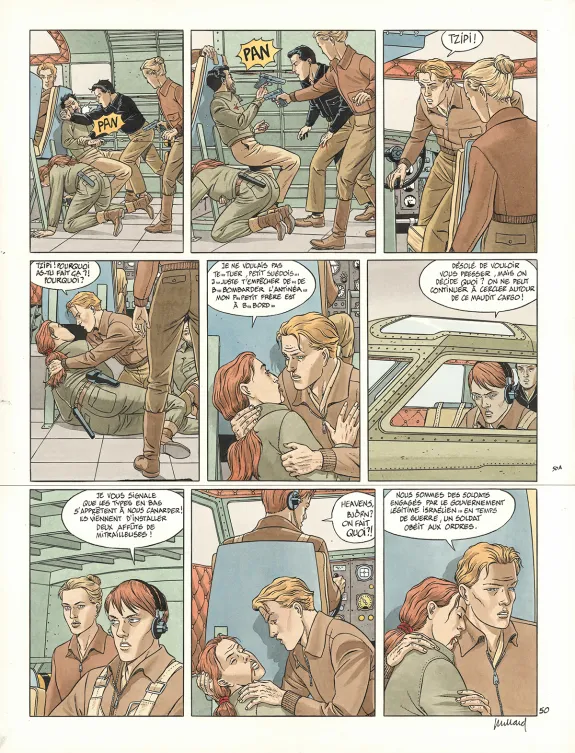
-
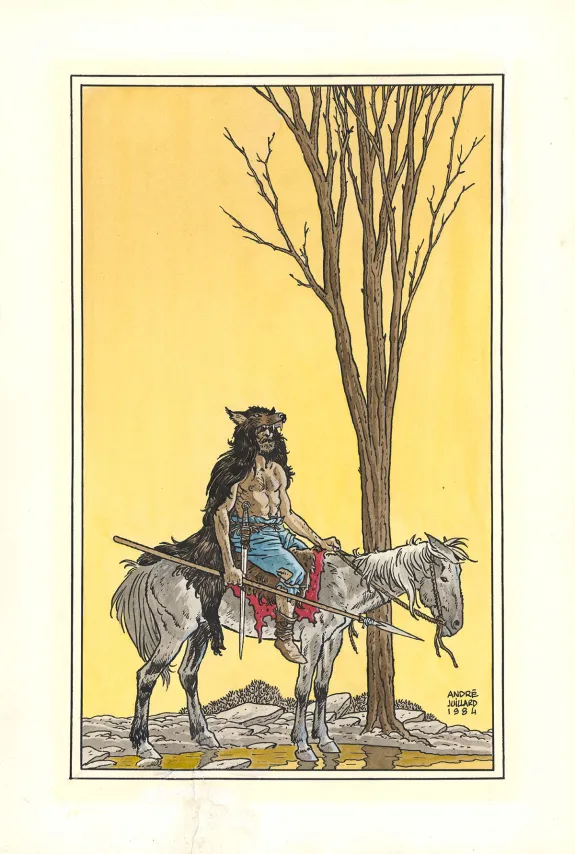
Original illustration, album back cover. Presence of a consolidated tear in the lower part of the…
3 000 € -
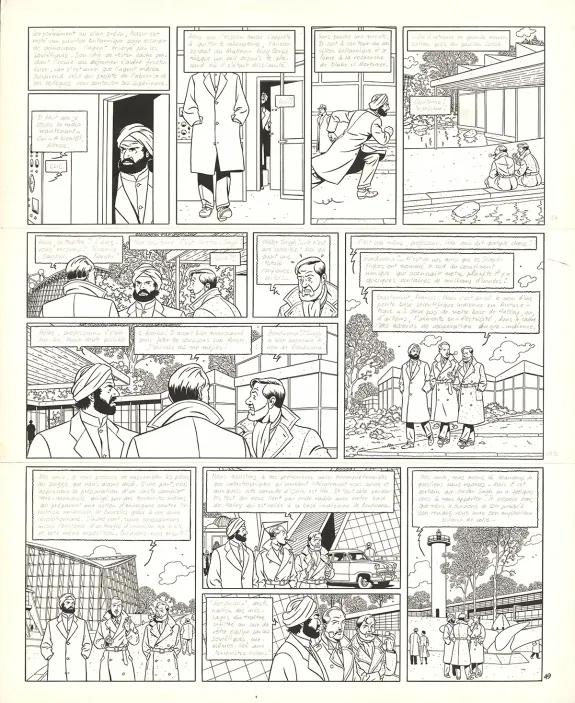
Planche originale n°49
3 500 € -