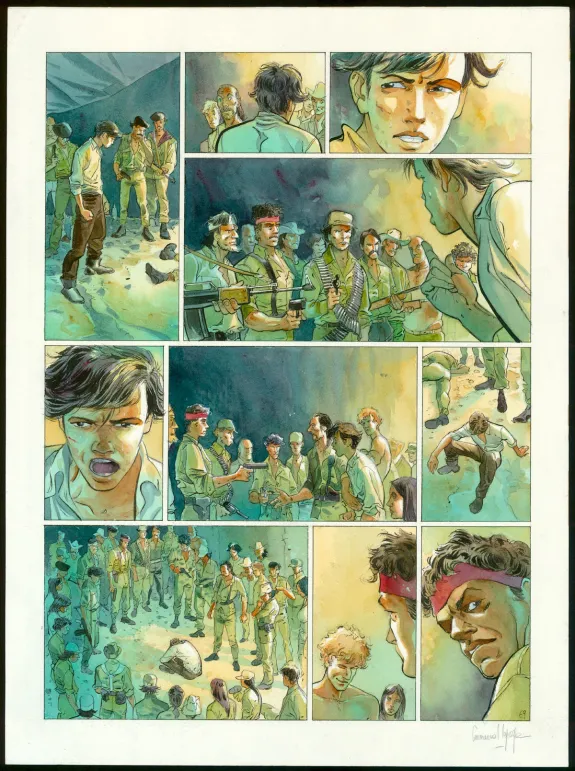
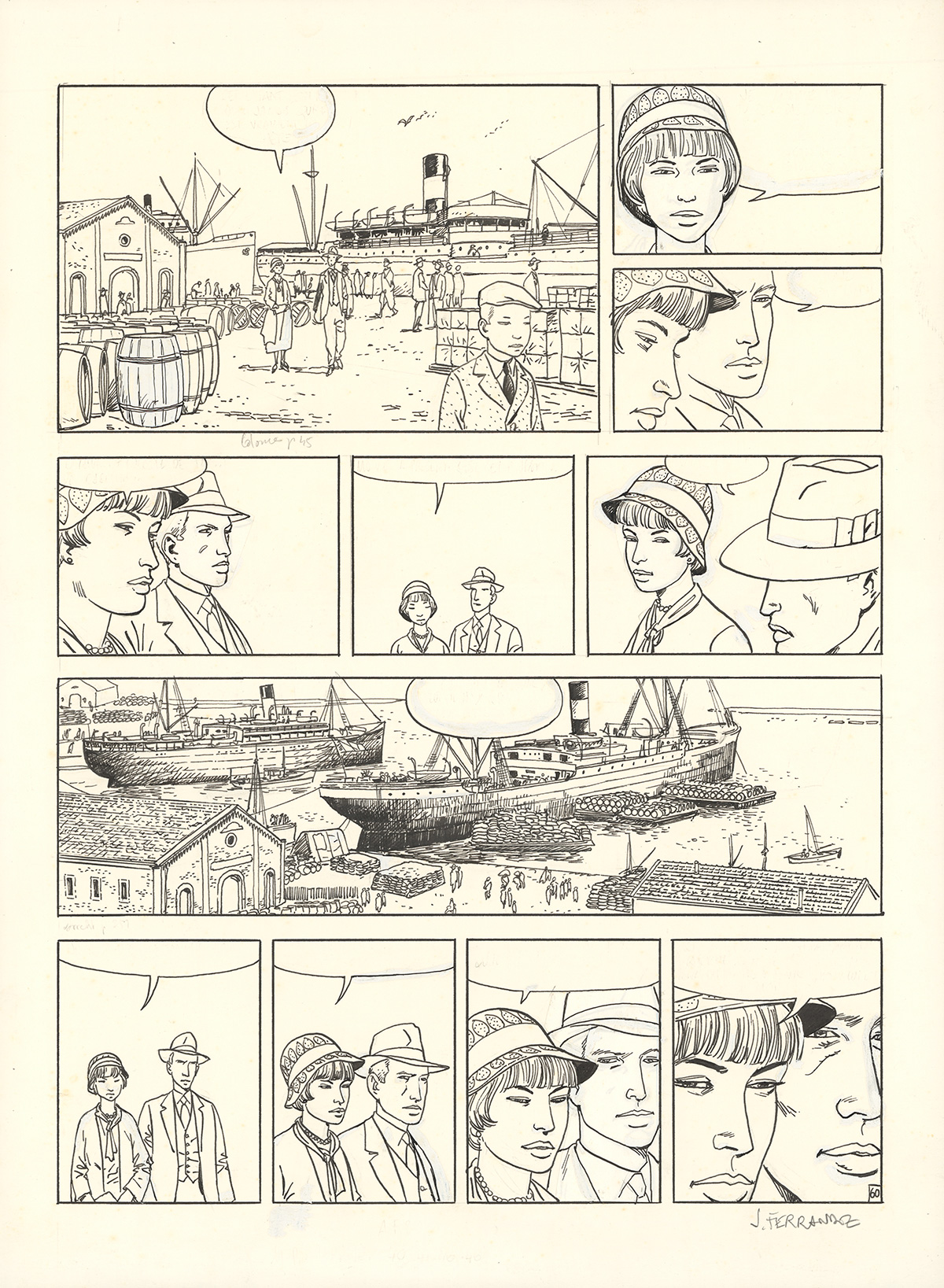
To ensure that your pages are kept in good condition, we recommend that you never expose them to direct light, as UV rays can damage the media used to produce them. Although Indian ink is a perennial material, the paper support may change when exposed to UV light. Note that watercolor plates require special attention, as this medium is particularly sensitive to light. Pieces containing pastel or charcoal require special care to avoid rubbing.
We advise you to display them away from windows, and to use frames made of pH-neutral conservation materials and “Museum” glass with anti-UV and anti-reflective treatment. If you prefer to keep your works unframed, we recommend storing them flat, in drawing cartons, with sheets of pH-neutral permanent paper in between. Keep them away from light and humidity.
Jacques Ferrandez (1955) trained at the School of Decorative Arts in Nice before making his debut in the magazine A Suivre in 1978. His masterpiece, Carnets d’Orient—a ten-volume epic on the French presence in Algeria published by Casterman—has established itself as an essential reference in the historical graphic novel genre. An avid traveler, he draws inspiration for his artwork from numerous travel journals—Les Tramways de Sarajevo, Retours à Alger, Cuba père et fils—in which watercolors and drawings capture the light and atmosphere of the places he has visited. He has also adapted three novels by Albert Camus (The Guest, The Stranger, The First Man) and Jean Giono’s Le Chant du monde. He returned to contemporary Algeria with the two-volume Suites algériennes before embarking on his diptych Orients perdus, published by Daniel Maghen. As much a painter as a storyteller, Ferrandez has created a luminous body of work bathed in the ochres and Mediterranean blues that instantly define his style. Complete biography.